Sleep, materials, and everyday design
Down Pillow Construction: What Chamber Design Changes
A pillow can be soft without being shapeless, lofty without being firm, and light without feeling insubstantial. Much of the difference lies not in the word “down” on its label, but in what happens inside the shell: how the fill is divided, where it is allowed to move, and how the pillow is meant to meet a sleeping head.
A down pillow seems, at first, almost too simple to require inspection. It is a fabric case, some feather-light fill, and a seam around the edge. Yet the small rectangle on the bed is an engineered object, and its construction is felt most clearly in the middle of the night, when a sleeper turns over and discovers that the pillow has either kept its place or migrated into a soft, unhelpful hill.
The arrangement of the fill can determine whether a pillow has a low, yielding profile or a more substantial lift; whether it springs back after being compressed; and whether it remains reasonably even from one side to the other. Chamber construction is one way manufacturers manage those qualities. It does not, by itself, tell you whether a pillow will be comfortable. It does tell you something useful about how the pillow is likely to behave.
Understanding that behavior makes shopping less like guessing at clouds. It also helps explain why two pillows described as down can feel remarkably different. One may collapse into a delicate envelope; another may keep a more definite outline. Between those experiences are choices about fill, compartments, dimensions, and profile—and, ultimately, about the particular way a person sleeps.
What a chamber is—and what it is for
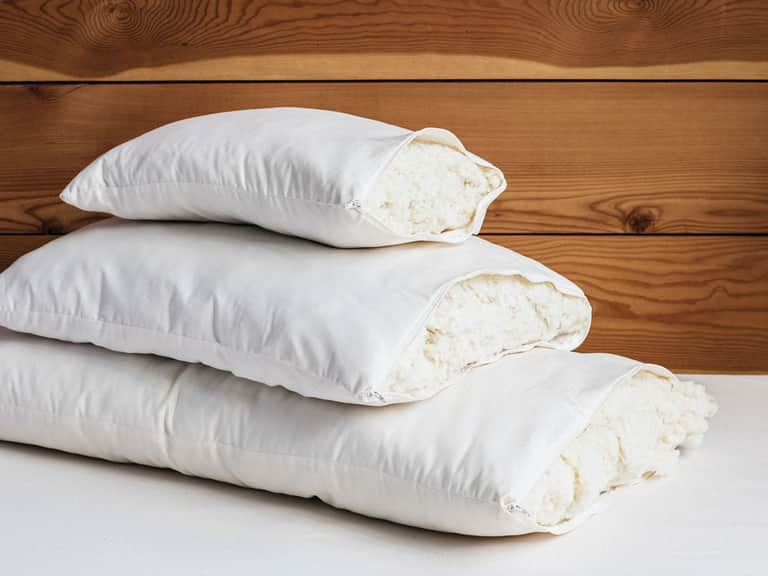
A chamber is a section within a pillow, created by internal fabric walls or seams. The barriers divide the interior into smaller spaces, each holding some portion of the fill. The simplest pillow may have one open cavity. More elaborate designs may use several compartments, sometimes arranged as a central core with softer outer sections, sometimes as a series of chambers intended to distribute fill across the pillow.
The purpose is control. In an undivided pillow, loose fill can travel wherever gravity, pressure, and a restless sleeper send it. Over time, the contents may gather along the edges or shift away from the area under the head. A chambered construction limits that drift. The internal walls give fill fewer places to go, helping the pillow retain a more consistent shape.
“Limits” is the important word. Chamber walls do not make fill immobile, nor do they promise that a pillow will never flatten. They influence the path it takes as it compresses and recovers. The effect depends on the number and arrangement of chambers, the amount and type of fill, the dimensions of each compartment, and the firmness of the shell. Construction is a system, not a single feature.
A well-made chambered pillow can feel more even because its contents are less likely to abandon the center. But the same internal structure can also make it feel more defined or less freely adjustable than an open-fill design. For someone who enjoys scrunching a pillow into a particular shape, that difference may matter as much as support does.
The five-chamber idea
A five-chamber pillow divides its interior into five zones. The exact layout varies by maker, so the number alone cannot reveal the full design. In some constructions, a central chamber contains a different quantity or type of fill from the outer chambers. In others, the compartments work together to reduce shifting and maintain a stable outline. The product description, rather than the label “five-chamber,” is where the useful details should be found.
A familiar version uses a central section for firmer or more supportive fill, surrounded by softer chambers. The aim is to provide a steadier place for the head while preserving a gentle surface feel. It is a little like building a small mattress within a pillowcase: a more structured interior, cushioned by the material around it. The design may feel more substantial than a pillow filled loosely from edge to edge, even when both use down.
The phrase “five chamber” is sometimes treated as a guarantee of better support. It is not. The number of compartments does not specify their size, the ratio of fill, the height of the pillow, or the firmness of the finished product. A five-chamber pillow can still be low and soft; another can feel fuller and more resistant. The construction offers a clue, not a verdict.
It is useful to ask what the chambers are meant to accomplish. Are they intended to prevent fill migration? To create a firmer center? To keep the pillow’s edges plump? Or simply to make the distribution more uniform? A clear answer is more informative than the number itself. If details are unavailable, the construction should be considered alongside the stated profile and feel, and—where possible—tried in person.
How chamber design affects loft and shape
Loft is the pillow’s height when it is resting in its natural, uncompressed state. It is often confused with firmness, though the two are not interchangeable. A high-loft pillow can be soft and compressible. A lower pillow can feel quite resilient if it contains compact, supportive fill. Chambering influences loft by helping the material remain distributed, but it does not create height by itself.
When the head presses down, down clusters compress and move around one another. In a simple open cavity, the fill may shift outward, leaving the center lower. A chambered construction restricts this movement, which can help the pillow recover a more even profile after pressure is removed. That does not mean it will feel rigid. Down remains compressible; its characteristic softness is part of its appeal. The structure is there to moderate the softness, not replace it.
The result is often a more predictable surface. A sleeper may find that the pillow feels similar from one night to the next, rather than requiring a ritual of folding, fluffing, and redistributing fill. This can be welcome for people who prefer a pillow that stays broadly in place. Others may prefer the freedom of an unpartitioned design, which can be kneaded, folded, and adapted more readily.
Shape retention also depends on the quality and quantity of the fill, the strength of the shell, and the pillow’s care. A chambered layout cannot compensate indefinitely for a pillow that is underfilled, poorly constructed, or exposed to improper washing and drying. Nor does it guarantee that every section will remain equally full forever. It is one contributor to stability, working alongside the materials and workmanship.
Support is a matter of alignment, not just height
A pillow’s job is often described as “support,” a word that can make a soft product sound as if it should behave like a block. In practice, useful support means that the head and neck are held in a comfortable position without an awkward angle or an unpleasant pressure point. The right pillow height depends on the sleeper’s body, position, mattress, and preference. There is no universally correct loft.
For a side sleeper, a pillow may need enough height to fill the space between the shoulder and the head. A very low profile may leave the head tilted toward the mattress; an overly lofty pillow may tip it in the opposite direction. A structured chambered design can help maintain a consistent surface, but the pillow must still be the right height for the person using it.
Back sleepers often look for a middle ground: enough lift to feel comfortable, without pushing the head too far forward. A softer down pillow may compress readily under the head, while a chambered design could offer a more stable feel. Whether that stability is welcome depends on how much the sleeper likes to sink into the pillow.
Stomach sleepers commonly prefer a lower profile, since extra height may turn the head sharply to one side. A lofty, tightly filled pillow may be a poor match even if its chamber construction is excellent. In this case, a low-profile design may matter more than the number of internal sections.
Sleep position is not a fixed category. Many people change positions through the night, and a pillow that feels right in one posture may feel different in another. Mattress softness matters as well: a shoulder can sink farther into a plush mattress than into a firmer one, changing the space the pillow needs to fill. These details make a brief comparison—lying down in the position you usually start in—more useful than judging a pillow upright in a shop.
Down, feathers, and the language of softness
Down consists of the fine clusters found beneath the outer feathers of waterfowl. Its structure traps air, giving it lightness and warmth. Feathers have a more defined central quill, and blends can feel different from pure down depending on their proportions and construction. Labels should be read carefully: the word “down” may describe a product family or blend, while the actual fill composition is provided elsewhere.
Fill composition and chamber layout answer different questions. Composition tells you what the pillow contains; construction tells you how that material is arranged. A pillow filled with down may still have a soft, shifting feel if it has a single open cavity. Another, using a similar fill, may feel steadier because internal dividers limit movement. Conversely, chambering does not necessarily make a pillow firmer if the fill remains light and highly compressible.
Shell fabric also enters the conversation. A tightly woven cotton shell can help contain fine fill and may give the pillow a smoother, more substantial hand. The shell’s weight, weave, and finishing affect how the pillow feels against the face and how readily air moves through it. If a pillow seems unusually firm for its stated fill, the shell and construction may be contributing to that sensation.
No material description should be taken as a complete account of comfort. A high fill-power figure, a particular chamber count, or an appealingly soft label can each tell part of the story. None can replace the practical question: does the pillow keep the head comfortable in the position in which it will actually be used?
Choosing between a chambered and open-fill pillow
An open-fill pillow has a certain informality. It yields to the hands, can be gathered into a ridge, and can be patted flatter. This flexibility appeals to sleepers who regularly reshape their pillow or enjoy a loose, cloudlike feel. Its potential drawback is that the fill may migrate, leaving the sleeper to restore the shape more often.
A chambered pillow tends to offer more organization. It may hold its general outline better and keep fill from collecting at one end. For a sleeper who wants a pillow that is not constantly being rearranged, that steadiness can be a virtue. For someone who likes to mold the pillow beneath the cheek or tuck an edge under the chin, the internal divisions may feel limiting.
A useful comparison begins with a few straightforward questions:
- Do you prefer to sink into a pillow, or to feel a more defined surface beneath your head?
- Do you often fold or scrunch your pillow to find a comfortable shape?
- Does your current pillow lose its shape because fill gathers at the edges or corners?
- What profile is comfortable for your usual sleep position and mattress?
- Does the maker explain the chamber layout, fill composition, and care instructions clearly?
If possible, test a pillow by lying on it for more than a moment. Notice the first impression, but also whether the pillow remains comfortable after the fill compresses. Try a gentle turn from side to back if that reflects how you sleep. The purpose is not to stage a perfect imitation of a full night’s rest; it is to avoid choosing solely by touch, when what matters is the pillow’s behavior under pressure.
Care, recovery, and the life of the pillow
A pillow’s shape changes with use. Regular fluffing helps redistribute the fill and restore loft, whether or not the pillow has chambers. Gentle handling is usually preferable to aggressive shaking, which can stress seams over time. Following the manufacturer’s care instructions matters particularly for down, since inadequate drying can leave moisture in the fill and affect its loft and freshness.
A washable cover or pillow protector can reduce the amount of skin oil and moisture that reaches the pillow itself. The outer pillowcase should be laundered regularly, while the pillow’s own cleaning schedule depends on its materials and construction. Some pillows are suitable for machine washing; others require professional care or spot cleaning. The care label is not a footnote to the purchase—it is part of the design.
With chambered pillows, inspect the seams and follow instructions for washing and drying without assuming that a familiar method is appropriate. Internal partitions may affect how fill moves during laundering and how thoroughly the pillow dries. If the manufacturer recommends a particular process, it is worth following it closely. A pillow that has been washed but not completely dried is not improved by the experience.
Reading a product description with a cooler eye
Descriptions of bedding can be lyrical. Fill is “cloudlike”; loft is “plush”; a construction is “supportive.” These are impressions, not standardized measurements. To make a useful comparison, look for concrete details: the fill materials and their proportions, whether the pillow has an internal chamber system, its stated profile, dimensions, shell fabric, and care requirements.
If the description says “five chamber,” look for an explanation of the layout. If it calls the pillow low profile, consider whether that matches your sleep position. If it promises shape retention, ask what feature is meant to provide it. A detailed description does not guarantee that a pillow will suit you, but it gives you a better basis for deciding than a procession of soft adjectives.
It is also worth distinguishing a pillow’s feel from its durability. A carefully divided interior may help the fill stay distributed, but longevity depends on fabric, seams, fill quality, use, and care. A warranty may offer additional information about the maker’s expectations, though it cannot predict whether the pillow will remain comfortable for a particular sleeper.
The quiet importance of fit
The best chamber design is not necessarily the most complicated one. It is the one whose structure supports the qualities a sleeper wants: a stable center, a lower profile, a soft surface, or a pillow that keeps its shape without constant adjustment. For some, that will mean a five-chamber construction. For others, the appeal of down lies precisely in its looseness and pliability.
The central lesson is to separate the questions. Chamber count describes an arrangement. Profile describes height. Fill composition describes material. Firmness describes resistance to compression, though makers may use the term differently. Together, these details help explain a pillow, but personal fit remains the final measure.
A pillow does not announce its engineering while you are falling asleep. It reveals it later, in the small negotiations of the night: whether the head settles easily, whether the neck feels unstrained, whether the fill has stayed where it was put. The chamber walls are hidden, but their effect is not. In a well-matched pillow, construction recedes into the background, leaving only the uncomplicated impression that the bed is ready to let you rest.